
How do I choose the right needle density for a mattress tufting machine?
- VIP-User
- 2026-08-12
- 18
Choosing the right needle density for a mattress tufting machine depends on mattress thickness, interior filling materials, and target plushness. High-density tufting enhances layer stability and firmness for heavy spring and memory foam mattresses, whereas lower needle density suits softer plush tops or latex layers. Matching density to structural requirements prevents material displacement and maintains uniform surface compression.
Core Solutions & Key Takeaways
- Material Compression Alignment: Denser needle configurations lock multi-layered spring and memory foam cores securely, preventing internal shifting during long-term use.
- Production Line Adaptability: Selecting the proper density balances structural tufting integrity with operation speed, achieving standard cycle rates of approximately 25 to 30 seconds per buckle process.
- Application Specifics: High-density tufting is optimal for hotel engineering mattresses and heavy-duty spring units, while lower density patterns cater to domestic soft latex and memory foam designs.
- Pneumatic Stability: Equipment operating at air pressures of 0.6 to 0.8MPa ensures uniform compression force regardless of needle placement spacing.
Detailed Architectural/Principle Analysis
Determining needle density requires evaluating the structural interplay between compressed internal components and outer ticking fabric. High-density tufting applies localized pressure across closer grid intervals, holding heavy pocketed springs, Bonnell units, and thick felt pads together. In automated workshops producing mass-market, hotel engineering, and e-commerce mattresses, density settings dictate both tactile firmness and overall product lifespan.
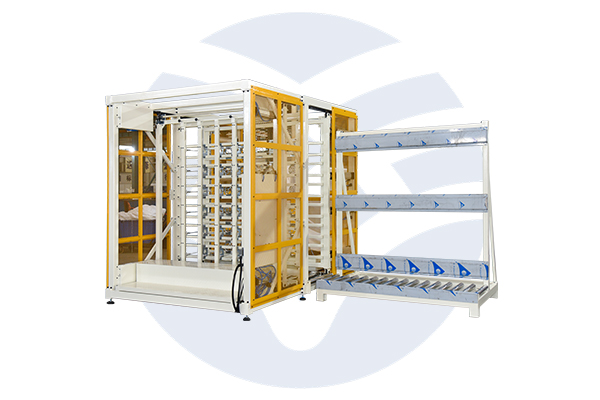
Modern equipment like the YT-CD-3A Advanced Mattress Tufting Machine operates with a total power consumption of 750W and requires 0.6 to 0.8MPa air supply to execute robust buckle insertion. High-speed operation allows a complete buckle cycle in roughly 25 to 30 seconds. Facilities upgrading from semi-automated setups to intelligent digital lines—such as international clients MOVEIS K1 LTDA in South America and HANVICO in Vietnam—utilize adjusted needle density controls to switch between different mattress model parameters smoothly.
Data/Solution Comparison
| Needle Density Setting | Recommended Mattress Type | Buckle Cycle Speed | Operating Air Pressure | Layer Anchoring Force |
|---|---|---|---|---|
Frequently Asked Questions (FAQ)
How does needle density affect the cycle speed of a mattress tufting machine?
Needle density dictates the total number of tufting points across the mattress surface. Higher density settings require more buckle cycles per unit, though individual point completion remains efficient at approximately 25 to 30 seconds per process on advanced pneumatic tufting systems.
Can standard pneumatic systems support high-density tufting configurations?
High-density tufting requires consistent pneumatic support. Systems configured for 0.6 to 0.8MPa supply pressure deliver stable drive force across closely spaced tufting points without loss of penetration power.
What role does mattress material thickness play when setting needle spacing?
Thicker, multi-layered mattresses require closer needle spacing to lock deep internal foam and spring combinations. Thinner mattresses maintain structural shape with wider spacing, preventing over-compression of outer quilting layers.
Final Conclusion & Recommendations
Selecting needle density involves evaluating layer thickness, fill materials, and required product firmness. Utilizing standardized machinery engineered for stable 0.6 to 0.8MPa operating pressures guarantees reliable execution across diverse mattress specifications. Adhering to strict production standards—such as ISO 9001 certified manufacturing frameworks—ensures precise tufting performance in high-output manufacturing environments. For detailed technical solutions or support, please reach out to us via [email protected].
About Us
Foshan Yuantian Mattress Machinery Co.,Ltd was established in 1982 and operates from a 150,000 square meter production facility with a workforce exceeding 100 employees. The company provides complete digital production line solutions and manufactures bed machinery across eight major series and 146 specifications. Operating under certified ISO 9001 quality management systems, it serves domestic and international clients in over 110 countries and regions.

Lastest
-
Is it possible to customize the sewing patterns and width on a mattress quilting series machine to match our brand's unique design?
2026-08-12 -
Are there any eco-friendly or high-speed alternatives to traditional mattress quilting series machines currently trending?
2026-08-12 -
How long is the typical production lead time for a mattress tape edge machine, and what are the standard shipping terms offered?
2026-08-12 -
How can I verify if a manufacturer of mattress tape edge machines has a real factory and reliable quality management systems?
2026-08-12 -
What is the average wholesale price and minimum order quantity for an industrial mattress tape edge machine from China?
2026-08-12
SUBSCRIBE
INQUIRY